Why Your AI Solution Fails
AI architecture discussions feel more complicated than the problems they're supposed to solve.
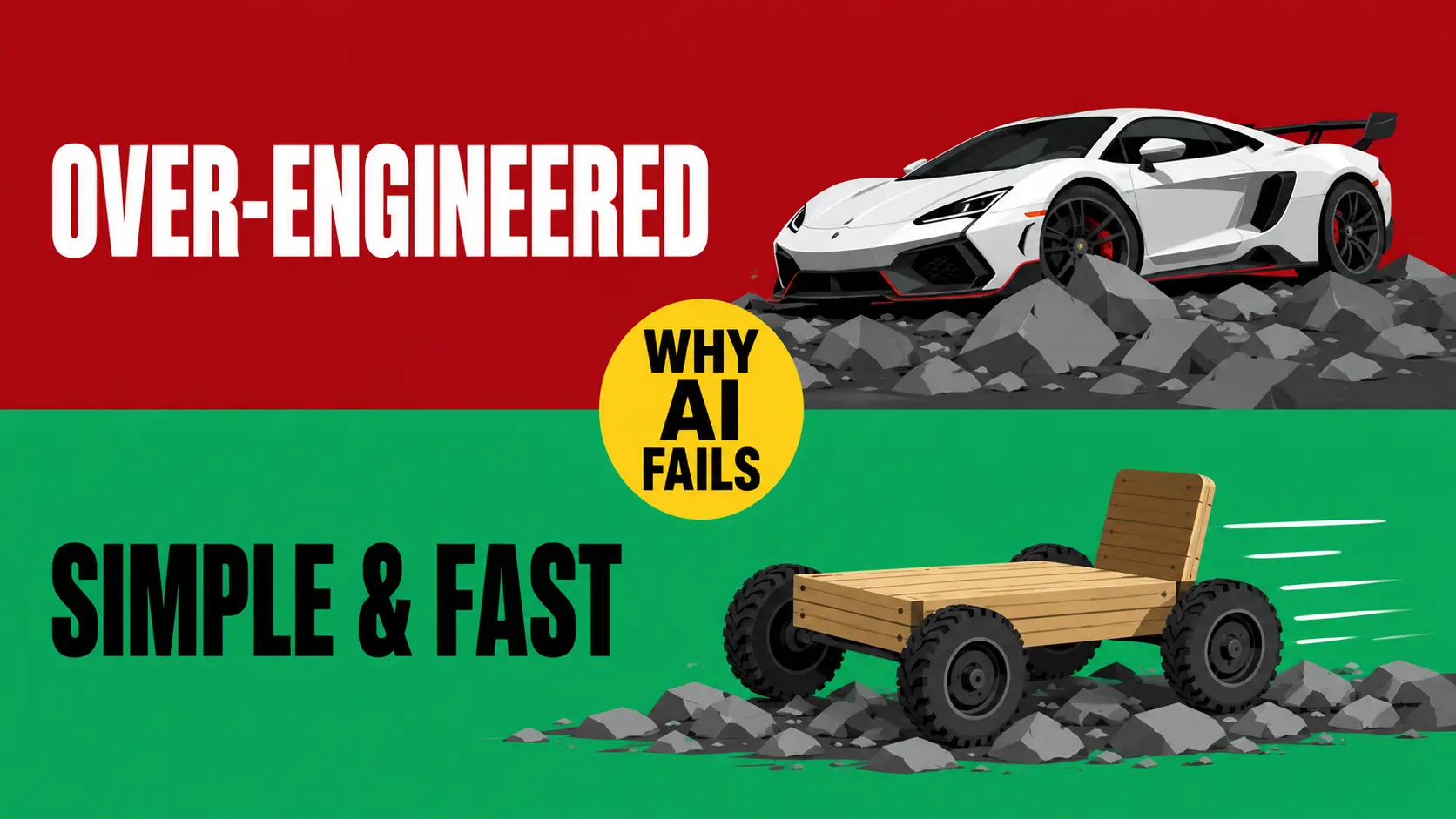
The most common pattern I see in failed AI deployments isn't a bad model choice or weak prompting. It's over-engineering. Teams reach for complex multi-agent pipelines, elaborate orchestration frameworks, and sophisticated retrieval architectures - before they understand their actual problem.
The architecture becomes the project. The problem it was supposed to solve becomes secondary.
The Complexity Trap
There's a gravitational pull toward complexity in AI systems. Part of it is genuine: LLMs introduce new failure modes that require new infrastructure. Part of it is social: complex architectures look more serious, more "production-ready," more defensible to stakeholders.
But complexity has costs that compound. Every additional component is a new failure mode. Every abstraction layer obscures what's actually happening. Every dependency is a surface area for drift, breakage, and debugging time.
I've watched teams spend three months building multi-agent orchestration systems that could have been replaced by a well-designed single-agent prompt with a few tool calls. The complex version wasn't more reliable - it was less. More moving parts, more ways to fail, harder to debug when something went wrong.
What Actually Causes Failures
When I trace back AI system failures to their root causes, the same categories show up repeatedly:
Context management failures. The model doesn't have what it needs to answer the question - or it has too much, and the relevant information is buried in a long context. Retrieval precision matters more than retrieval recall for most production tasks.
Distribution mismatch. The system was tested on one distribution of queries and deployed against a different one. This is almost inevitable with real users - the gap between test data and production data is always larger than expected.
Missing human-in-the-loop design. The system was designed as fully automated before the team understood where the model's reliability boundary was. Automation should be earned through demonstrated reliability, not assumed from the start.
Undefined success criteria. "The AI should answer questions about our policy documents" is not a success criterion. "The AI should answer policy questions with >90% accuracy, <2s latency, and explicit citations that a compliance officer can verify in 30 seconds" is. Without measurable criteria, you can't know if the system is working.
Smarter Context, Not More Complexity
The teams building reliable AI systems right now are solving a context problem, not a model problem. They're asking: what exactly does the model need to know to answer this question? How do we get precisely that context, with minimal noise? How do we structure it so the model can use it reliably?
That's a data engineering and product problem, not an ML engineering problem. The teams that treat it as a model problem keep swapping architectures. The teams that treat it as a data problem keep shipping.
A More Useful Starting Point
Before reaching for a complex architecture, get crisp answers to:
- What specific task is the AI performing? (Not "answering questions" - what exactly?)
- What information does it need to perform that task? (What's in context when it succeeds vs. fails?)
- What does "correct" look like, and how will you measure it?
- Where in the workflow does a wrong answer cause real harm, and what's the mitigation?
Most teams that work through these questions carefully find their architecture problem simplifies dramatically. The future of vertical AI agents isn't complex pipelines - it's teams that understand their problem well enough to build the minimum system that solves it.
Want this implemented in your workflow?
I work with SaaS companies, real-estate, finance, and regulated-industry teams on AI adoption. Book a 20-minute strategy call - no pitch, just a focused conversation about your situation.
I publish one post like this per month. Join AI Command Room and I'll send it directly to you.